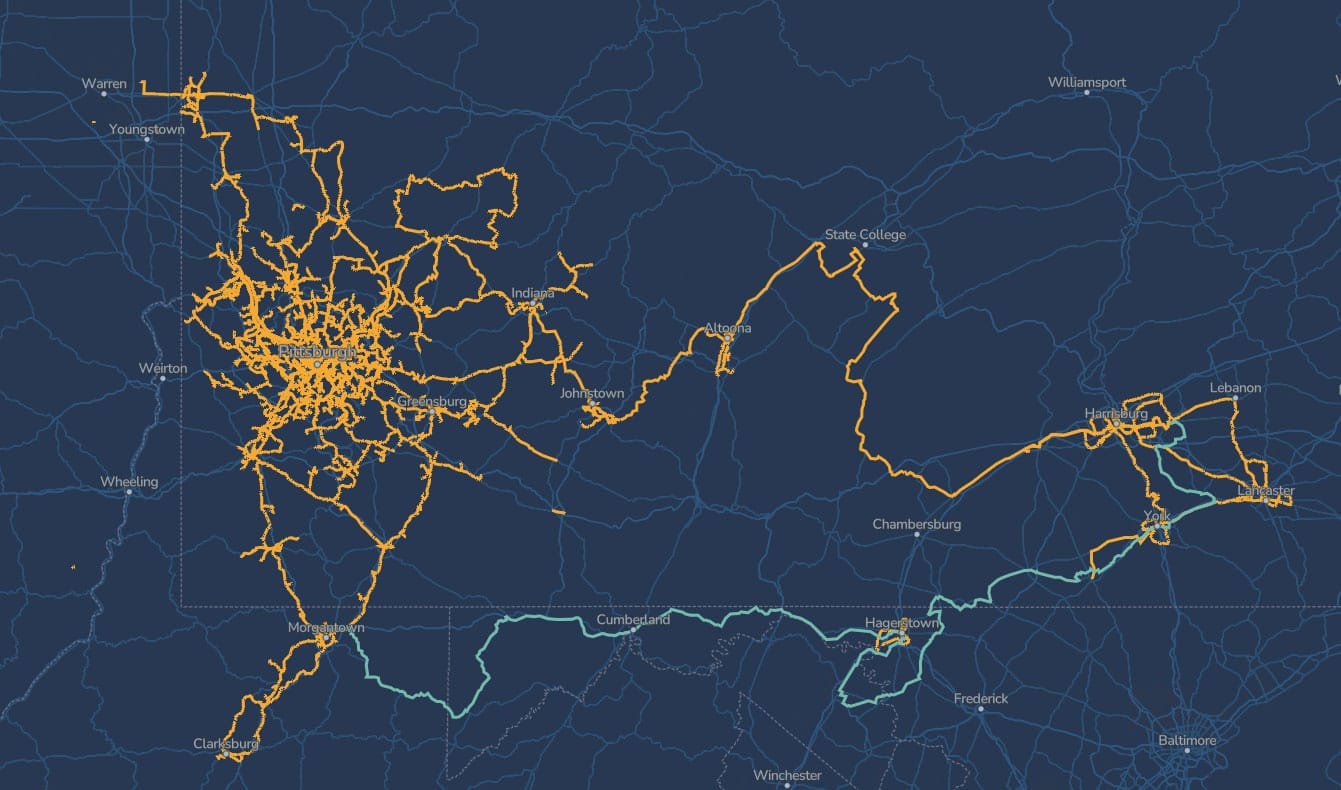


Hyperscale Fiber Infrastructure in Pennsylvania: Why Regional Networks Win
Hyperscale AI sites are chosen for power first. But once a site is approved, fiber becomes non-negotiable.
A recent article by Mike Sicoli, CEO of DQE Communications, explains why regional fiber providers are uniquely positioned to accelerate AI data center deployments and hyperscale fiber infrastructure in Pennsylvania. While national carriers optimize for scale and standardization, regional networks deliver speed, local execution, and flexible designs that meet day-one connectivity requirements while permanent underground infrastructure is built in parallel.
The piece also outlines a proven pattern: power attracts hyperscalers, fiber follows, and new regional interconnection hubs emerge. As AI shifts from centralized training to edge inference, established regional networks are already in place to support what comes next.
Power Gets You to the Table. Fiber Gets You Online.
If you’re evaluating sites for a hyperscale training campus, a GPU cluster, or a high-density inference deployment, you already know how the search starts: with power. AI data centers now require 50 to 150 kilowatts per rack, five to ten times traditional loads, which means gigawatt-scale power availability is the gating factor for shortlisting any region.
Western Pennsylvania checks that box. Marcellus Shale natural gas enables on-site power generation at scale. Legacy industrial sites offer existing infrastructure and developable land. Retired coal plants are being repurposed for natural gas and renewable generation. The region is a serious contender for multi-gigawatt AI infrastructure, and policymakers from the governor’s office to Capitol Hill are actively competing for that investment.
But here’s what gets underestimated in site selection: the moment a site is chosen, fiber stops being a checkbox and becomes a critical path item. And the wrong connectivity partner can quietly cost you months. The question is who builds your hyperscale fiber infrastructure in Pennsylvania — and how fast they can move.
Hyperscale Fiber Requirements: Route Diversity, Underground Build, and Day-One Connectivity
Your requirements aren’t enterprise requirements. They aren’t even traditional carrier requirements. You need at least four diverse, high-capacity underground fiber routes connecting to major internet hubs like Ashburn, Columbus, Chicago, and Secaucus, and those paths must be truly diverse: never crossing, physically separated end-to-end.
Most of Pennsylvania’s existing fiber plant is aerial, built over decades to serve enterprises, wireless carriers, schools, and multi-tenant colocation facilities, none of which needed what you need. That’s the honest starting point.
But it’s not the barrier it might appear to be. Here’s the math that matters: a purpose-built fiber investment for a hyperscale site runs tens of millions of dollars. The data center facility and associated power generation runs tens of billions. Fiber is a rounding error in your total capex, and it can be executed well within the 24-plus-month construction window for the facility itself. You don’t need perfect fiber at groundbreaking. You need adequate, diverse connectivity on day one, with permanent underground infrastructure coming online in parallel.
DQE delivers dark fiber and high-capacity wavelengths purpose-built for exactly this phased approach. That phased approach to hyperscale-grade fiber infrastructure is exactly what a capable regional partner is built to deliver.
Why Regional Fiber Providers Outperform National Carriers for AI Data Center Deployment
National carriers are optimized for national scale. That’s a feature for some customers and a liability for yours. When you need a specific route engineered to your conduit spec on an aggressive timeline in a genuinely complex permitting environment, a team dispatched from out of region faces a steep learning curve on PennDOT rights-of-way, utility pole access negotiations, railroad crossings, and relationships with 2,500-plus municipalities across the state.
Regional providers have been solving those problems every day for decades. They know the terrain, the regulators, the landowners, and the workarounds. They can reach proposed hyperscale sites quickly with diverse aerial plant to satisfy day-one requirements while purpose-built underground routes are under construction. And because they aren’t trying to fit your deployment into a standardized national product catalog, they can co-develop exactly what you need — specific routes, specific conduit configurations, specific build timelines — as a genuine partner rather than a vendor processing a ticket.
Worth knowing: permitting timelines for fiber applications currently run 8 weeks to 6 months depending on jurisdiction. Local relationships compress that. Out-of-market teams don’t have them.
How Hyperscale Investment Turns Emerging Markets Into Interconnection Hubs
Ten years ago, Columbus, Ohio wasn’t on anyone’s connectivity map. It wasn’t a peering destination. It wasn’t in the same sentence as Ashburn or Secaucus. Then power availability and pro-development policy attracted hyperscalers.
Hyperscalers attracted fiber investment. Fiber investment created interconnection density. And Columbus organically became a legitimate internet exchange point where hyperscale tenants discovered they could hand off significant traffic volumes locally rather than backhaul everything across the East Coast. Nobody planned that outcome; it just followed from the infrastructure.
Pittsburgh is positioned to follow the same arc. Multiple hyperscale operators in the region would quickly justify the underground fiber investment required for true route diversity and redundancy, and the region would emerge as a strategic interconnection hub that compounds the value proposition for every deployment that follows. The AI Summit in Pittsburgh last year, attended by the President, the Governor, and both Pennsylvania senators, signals the kind of political alignment that tends to accelerate exactly that trajectory.
AI Inference at the Edge: Why Regional Fiber Infrastructure Matters Beyond Training Campuses
Training infrastructure dominates the headlines, but AI value is delivered at the edge, through inference, and inference workloads are about to scale dramatically. As AI products mature and user-facing applications grow, operators will need high-performance, low-latency connectivity reaching distributed locations: colocation facilities, hospitals, manufacturing plants, universities, enterprise office buildings.
This is a present-day regional network problem, not some far-off infrastructure challenge, and established regional providers are already connected to those endpoints. The same network that gets your training campus online on day one is the same network that serves your inference deployment at scale. Regional fiber infrastructure isn’t just a bridge to your permanent buildout. It’s the long-term substrate for the AI economy in emerging markets.
What This Means for Your Site Selection Process
If you’re evaluating hyperscale fiber infrastructure in Pennsylvania, or any emerging market, for hyperscale AI infrastructure, the practical takeaway is straightforward: engage regional fiber partners early, before national carriers anchor your connectivity strategy. The cost difference is minimal. The speed and flexibility advantage is significant. And the local knowledge required to navigate complex permitting environments is not something you can import on short notice.
Pennsylvania has the power and the land. It has bipartisan regulatory momentum and a technical workforce anchored by Carnegie Mellon and the University of Pittsburgh. The fiber infrastructure gap is real and it is solvable, with the right partners at the table from day one.

About DQE Communications
DQE Communications is a business-only fiber network provider serving enterprise organizations, hyperscalers, and carriers across Pennsylvania, West Virginia, and Maryland. DQE delivers dark fiber, dedicated internet access, Metro Ethernet, and wavelength services purpose-built for the reliability, route diversity, and day-one connectivity that hyperscale fiber infrastructure in Pennsylvania demands. DQE’s Pennsylvania-based Network Operations Center operates 24/7/365, and every account has a dedicated support team — not a portal, not a queue.
Evaluating a site for hyperscale AI infrastructure?
Talk to DQE before national carriers define your connectivity options.
We’ll walk through your site’s fiber requirements, identify route diversity options, and show you what DQE can deliver on day one while permanent underground infrastructure is built in parallel.
Read the full article: The Invisible Backbone of AI by DQE Communications CEO Mike Sicoli.
FAQ
Hyperscale Fiber Infrastructure and AI Data Center Connectivity
Physical route diversity means that fiber paths between locations travel through entirely separate conduit, rights-of-way, and geographic corridors so that a single construction accident, natural event, or equipment failure cannot sever more than one path simultaneously. For a hyperscale AI data center, a connectivity failure that takes down multiple routes is not a network incident — it is a business-stopping event affecting training runs, inference workloads, and enterprise customers simultaneously. Logical redundancy on a shared physical route does not protect against this. True route diversity requires separate physical paths, and verifying that diversity requires a regional partner who knows exactly where every strand in the ground runs.
Aerial fiber runs on utility poles above ground and is faster and cheaper to deploy, making it appropriate for satisfying day-one connectivity requirements while permanent infrastructure is under construction. Underground fiber is direct-buried or placed in conduit below grade, offering greater physical protection, longer service life, and the route diversity that hyperscale deployments require for their permanent network architecture. The standard approach for emerging hyperscale markets is a phased build: aerial plant provides diverse connectivity from day one, with purpose-built underground routes coming online in parallel with the facility construction window, typically 24 months or more.
National carriers optimize for standardized products and national-scale deployments, which creates friction when a hyperscale customer needs a custom route, an aggressive build timeline, and navigation of complex local permitting environments. Regional fiber providers have existing relationships with state transportation departments, utility pole access authorities, railroad crossing operators, and local municipalities that compress permitting timelines from months to weeks. They can co-develop specific conduit configurations, specific routes, and specific build schedules as a genuine partner rather than a vendor processing a request through a national product catalog. In Pennsylvania, permitting timelines for fiber applications currently run 8 weeks to 6 months depending on jurisdiction. Local knowledge is the only thing that moves them toward the shorter end.
A phased fiber approach delivers adequate, diverse connectivity on the day a hyperscale facility opens while permanent underground infrastructure is built in parallel with the facility itself. In phase one, a regional provider deploys diverse aerial routes to the site, providing the redundant connectivity hyperscale operations require from day one. In phase two, purpose-built underground routes are engineered and constructed during the facility’s own construction window, arriving online before or concurrent with full operational capacity. This approach eliminates the false choice between waiting for perfect infrastructure and accepting a single-path dependency at launch. Fiber investment at the scale hyperscale facilities require is a rounding error against total facility capex, and a phased build executes well within a standard construction timeline.
Fiber deployment for a hyperscale site requires permits and approvals from multiple jurisdictions simultaneously: state transportation departments for rights-of-way along highways, utility pole authorities for aerial strand access, railroad operators for crossing agreements, and individual municipalities for local road work. In Pennsylvania, there are more than 2,500 municipalities, each with its own permitting process. Timelines across these entities currently range from 8 weeks to 6 months depending on jurisdiction, project scope, and the applicant’s existing relationships with local regulators. Regional providers with decades of in-market permitting experience compress these timelines through established relationships that out-of-market teams cannot replicate on short notice.
AI training campuses require massive, concentrated bandwidth between a small number of locations: the campus itself, major internet exchange points, and cloud on-ramps for dataset access. AI inference infrastructure has the opposite topology: it requires high-performance, low-latency connectivity reaching a large number of distributed endpoints such as colocation facilities, hospitals, manufacturing plants, universities, and enterprise office buildings where AI applications are actually used. Regional fiber networks are uniquely suited to inference infrastructure because they are already connected to those distributed endpoints through years of enterprise and carrier buildout. The same regional network that delivers hyperscale training campus connectivity on day one is the network that serves inference deployments at scale as AI products mature.
Hyperscale fiber infrastructure in Pennsylvania for AI data centers require a minimum of four physically diverse, high-capacity underground fiber routes connecting to major internet exchange points such as Ashburn, Columbus, Chicago, and Secaucus. Physical diversity means the routes must be separated end-to-end with no common conduit, rights-of-way, or crossing points. Most existing regional fiber plant is aerial and was built for enterprise and carrier customers rather than hyperscale requirements. Regional fiber providers with experience in purpose-built underground infrastructure are best positioned to deliver the route diversity and capacity that a hyperscale deployment demands on day one and at permanent scale.